Showing posts with label film reviews. Show all posts

Monday, 24 March 2014

The Wicker Man (1973) Film Review

Fig 1: The Wicker Man (1973) Poster
The film 'The Wicker Man'  is an incredibly suspense-filled cult classic; with a plot pumped full with misdirection, screenplay that keeps the audience shivering on the edge of their seats and a completely estranged visual experience that fools delightfully with a viewer's preconceptions of religion.

"Anthony Shaffer penned the screenplay which, for sheer imagination and near-terror, has seldom been equalled." (Variety Staff 2008)

The screenplay of 'The Wicker Man' is both parts mysterious and disturbing. Its use of old Pagan traditions, beliefs and mannerisms give it a strange feel from the very start which only grows stronger as Sergeant Howie, from the Scottish mainland police force, investigates the disappearance of the young girl, Rowan Morrison. The film, as noted in the quotation above, is extremely imaginative as it makes superb use of all aspects of Pagan belief to frighten an audience unfamiliar with them, it blends these beliefs so seamlessly into a familiar modern environment which confuses and astonishes audiences when it becomes suddenly clear what is taking place on the island. 

Fig 2: Maypole Scene in 'The Wicker Man'

"Edward Woodward is pitch-perfect as Sergeant Howie. He makes a character who, to be honest, is not extremely likeable into a sympathetic figure. We root for him in spite of his flaws because Woodward is so genuine, so thoroughly convinced that he is a righteous man in a community of depravity." (Gonzalez 2008)

The strong characterisation of Sergeant Howie is such a vital role to 'The Wicker Man' that without it, the film as whole cannot function. While 'The Wicker Man' makes good use of its many characters , It is Sergeant Howie who acts as a conduit between the audience and the film's focus, his voicing of opinions and observations act as vocalisations of audience opinion during the many events, but his winding path in investigating the disappearance of Rowan gives very little straightforward movement in the tale and is the main tool of misdirection in the plot, deceiving the audience all the way up to its horrifying conclusion.

Fig 3: The Burning Wicker Man scene in 'The Wicker Man'
"hardly anything surpasses that clifftop finale for freakish terror" (Quinn 2007)

The finale of the 'The Wicker Man' has be immortalised as one of the greatest filmic twists of all time, the sudden change from daring escape to elaborately planned trap is almost unforeseen to audiences during the events leading up to it.It is only upon re-examination of moments through out the film that a much more sinister plot can be revealed. The entire film is rife with symbolic elements of it conclusion, hinting ever so subtly at Sergeant Howie's approaching demise. An example of these would be the use of rabbit imagery, from the finding of a rabbit carcass in Rowan's supposed grave to the beheading of the rabbit headdress during the mayday ritual, the rabbit can be interpreted as a representation of Howie himself, an innocent animal being killed by the predators around it. Another example would be the constant temptation and torment of Howie by the villagers; Willow's constant on screen sexual allure, the pursuit around the village, their constant carelessness about Rowan, etc. When re-examined with the ending in mind, each of these, and many more, instances are engineered circumstances and are organised to test Sergeant Howie's resilience, fortitude and belief as a Christian to their limits, so the village knows they have the perfect human sacrifice for the mayday festival and their gods. This feeling, evoked by the films end, grows more powerful even after it is viewed. It casts the film in a extremely sinister light and moves it away from suspense thriller it seems to be altogether and instead moves into the realm of absolute horror, this echoing fright shadows each character's every word, their every action becomes malicious and deceitful as the perfectly engineered, elaborately organised plot moves Sergeant Howie ever closer to his sickening demise, like a lamb to the slaughter.

List of Illustrations

Fig 1: 'The Wicker Man' poster [Poster] At: http://upload.wikimedia.org/wikipedia/en/thumb/a/ae/TheWickerMan_UKrelease_Poster.jpg/220px-TheWickerMan_UKrelease_Poster.jpg

Fig 2: Maypole scene in 'The Wicker Man' (1973) Directed by Robin Hardy. [Film Still] United Kingdom: British Lion Films. At: http://optimumscreenings.co.uk/press/wickerman/WM-014.jpg

Fig 3: The Burning Wicker Man scene in 'The Wicker Man' (1973) Directed by Robin Hardy. [Film Still] United Kingdom: British Lion Films. At: http://ferdyonfilms.com/Wicker%201.jpg

Bibliography

Gonzalez Jr, Felix (2007) At: http://www.dvdreview.com/reviews/pages/2556.shtml [Online Review] (Accessed 24/03/2014)

Quinn, Anthony (2007) At: http://www.independent.co.uk/arts-entertainment/films/reviews/the-wicker-man-15-462732.html [Online Review] (Accessed 24/03/2014)

Variety Staff (2008) At: http://variety.com/1972/film/reviews/the-wicker-man-1200422895/ [Online Review] (Accessed 24/03/2014)

Tuesday, 11 March 2014

Memento (2000) Film Review

Fig 1: 'Memento' (2000) poster
The film 'Memento' (2000) is a complicated narrative that has no steady point in time and constantly flicks backwards in time, with each new scene ending on an identical series of events to the start of the last. This narrative style can be extremely confusing for any audience that falls behind the story's progression but 'Memento' use this style in a rhythmic and entrancing way that keeps the audiences viewing experience fresh and interesting until the final twist.

"Occasionally the film trips over its own complexity, but it's tense, devious and evokes Leonard's disorientation quite brilliantly." (Film4 2000)

The film's complex narration works both as a unique method for portraying and telling the story while also acting as a representative element of a Leonard's constant confusion and absolute disorientation to the world around him. This works very much to 'Memento's advantage as the story backtracks to its beginning, the many overlapping scenes throughout reveal an increasingly twisted plot and eventually shows Leonard's conscious decision to fool himself. This final, or initial, twist uses the main plot device, Leonard's inability to make memories, to completely change the audiences perception and interpretation of established events and the even the plot itself, with us thinking that "Teddy" is John G, Leonard's target, for almost all of the feature.

Fig 2: Death of "Teddy" from 'Memento' (2000)
"Memento is one of those jigsaw puzzles whose pieces snap together more tightly with each viewing. Fueling it all is a performance by Guy Pearce that's as indelible as the tattoo ink covering his body. He's a mural of vengeance." (Nashawaty 2011)

The complex characterisation of Leonard, the film's protagonist, is both confusing and morally questionable. The character's motives are completely clear from the very beginning, with the subsequent death of "Teddy" in the first scene. His desire for revenge is the very basis for this character as he follows this drive on the hunt for his wife's supposed 'killer'. A fact which itself turns out to be false, with Leonard's subconscious lying to him and concealing the truth of his situation and past within a story he tells again and again. These defining features of Leonard's character for the duration of the film can be seen as ironic, as he makes a point of telling others how memories can be twisted and unreliable but he, himself places complete faith in his own memories. The story he constantly tells, the story of Sammy Jankis, is his own mind taking a third person perspective on the events proceeding his wife's rape and supposed murder and the way in which this story lingers around Leonard shows an unconscious attachment to the events and his guilt surrounding it proves to be an unconscious acknowledgement of his involvement in his wife's overdose.

Fig 3: Sammy Jankis from 'Memento' (2000)
"More than an enigmatic, jittery, occasionally funny treatise on vengeance's fruitlessness, "Memento" never abandons an emotional quandary: How can a man unable to feel time expect to heal? Leonard loses himself, as we all do, in habit and repetition." (Rogers 2010)

It becomes painfully obvious by the very end of the feature that Leonard is lost within his own concept of time and the world around him. He judges the inconsistencies and uncertainties of reality, criticsing the people around him and their dependency on what he himself has lost. This proves to be true until quite a way into the film, when the audience begins to see the twisted plot unravel in front of them; with Leonard's manipulation by Natalie, a drug dealer's girlfriend, and then his own manipulation of his memories. He exploits his own memories by essentially using his only routine and loop hole, his trust in himself; he intentionally manipulates himself to please a now instinctual feeling of revenge. This is revealed nowhere better than when "Teddy" confronts Leonard with the truth his reality and his eternal and routine hunt for the ever elusive "John G".

List of Illustrations

Fig 1: 'Memento' (2000) poster [Poster] At: http://www.impawards.com/2001/memento.html

Fig 2: Death of "Teddy" from 'Memento' (2000) Directed by Christopher Nolan. [Film Still] America: Newmarket Films and Team Todd. At: https://blogger.googleusercontent.com/img/b/R29vZ2xl/AVvXsEiC9-RHQRb19rd6hkP0W3YDnoEdDFkoL-g607GZKQz8_0IWA0_oi-4ghUmBbh2zpwn_4gpN8B_dMDcyaq3ENN_1W9jP443bKOYb0vPV9o5B_djjR-GgzhUFUoD-JSFTguUlgH4EBO4vh7Di/s1600/memento+still+5.jpg

Fig 3: Sammy Jankis from 'Memento' (2000) Directed by Christopher Nolan. [Film Still] America: Newmarket Films and Team Todd. At: http://taylorholmes.com/wp-content/uploads/2010/07/memento09.jpg

Bibliography

Film4 (2000) At: http://www.film4.com/reviews/2000/memento [Online Review] (Accessed: 11/03/2014)

Nashawaty, Chris (2011) At: http://www.ew.com/ew/article/0,,20466686,00.html [Online Review] (Accessed: 11/03/2014)

Rogers, Nick (2010) At: http://www.rottentomatoes.com/m/memento/ [Online Review] (Accessed: 11/03/2014)

Tuesday, 18 February 2014

The Blair Witch Project (1999) Film Review

Fig 1: 'The Blair Witch Project' (1999) Poster
'The Blair Witch Project' (1999) is a found footage genre film that tells the story of three students and the events leading up to their disappearance. The film was captured using a handheld camera and a 16mm black and white camera and while use of handheld equipment is almost a must for this films genre, the black and white film camera gave a sense of realism as it worked with the plot but also invoked its own form of horror by depriving scenes of colour and increasing contrast between light and dark, a feature which makes it almost invaluable in the final scene's house and basement. The script and dialogue is massively improvised with the actors given only an outline of how the story would unfold, their performances under such conditions bring a sense of complete realism and evokes a primal fear with the viewer as the characters only get more and more lost and convinced of their situation as hopeless.

"The Blair Witch Project" is the scariest movie I've ever seen. Not the goriest, the grossest, the weirdest, the eeriest, the sickest, the creepiest or the slimiest... Just flat out the scariest." (Rose 1999)

The way in which 'The Blair Witch Project' presents its horror element is simplistic in nature with what you don't see being the scariest thing of all, this is because it use intense audience participation, making use of their imagination and personal fears to fill in the blanks of the footage. The films found footage style goes along way in bringing absolute fear to the audience with the seemingly realistic actions and emotional portrayal of its cast; its camera work exercises two radically different angles of approach with black and white documentary like shots presenting the information clearly while the handheld colour camera symbolically gives us a view from the character's perspective, with us being unable to see very much at all and completely overwhelmed at times by the events around us.
Fig 2: Graveyard documentary scene in 'The Blair Witch Project' (1999)
"The directors took their cue from producer Hale's Army training and shot the film like a military exercise." (Travers 1999) 

The way in which the films was recorded and produced was unique and made incredibly tough for the actors. As Travers highlights above, the film was 'directed' loosely with the actors receiving their directions to the next location via milk crate dead drops. This gave emotional realism as the actors blindly followed these directions, improvising their dialogue as they went, and become both physically and emotionally drained. The night time scenes are frightening and mind boggling for not just the audience, as the actor's and their characters are harassed continuously to varying degrees in the dark woods, only to be unsettled and unhinged ever so slowly through out the day with stick puppets, stone piles and the surplus of unexplained noises echoing around them. The film gains from this unique style by capturing realist emotions of the cast as their harrowing journey slowly comes to a close; Heather Donahue, the female lead, can be noted for really pulling on the audience's heart strings as she becomes more and more unhinged and completely desperate to escape the situation, something that can be said for all three of the students however she evokes their sympathy the most through her heart wrenching video as she claims responsiblity for the events and begins to carry the heavy guilt associated with this. Her words "I'm scared to close my eyes and I'm scared to open them" becomes a singularly memorable line as it encapsulates the entire experience's emotional conclusion as it leaves each member of the audience in a similar state of terror, dread and paranoia.

Fig 3: Donahue's crying confession in 'The Blair Witch Project' (1999)
The overarching plot of this psychological horror montage is incredibly insubstantial and merely acts as a guided tour of its constructed lore.

"While it has its scary moments, and while its central conceit is refreshingly imaginative, there's ultimately not much there there." (Brunette)

The films plot is extremely elusive throughout the entire feature, with screen time dominated by the character's improvised dialogue and the tormenting actions of the directors, the goal of the three students soon becomes bogged down under all of its excess weight. The antagonist in the film is not entirely clear, it is hinted to be the witches through the strange dolls, rock piles and then the final scene in the old basement, but it is never clearly defined. This mystery of course lends itself to making the feature all the more frightening as the invisible and unknown aggressor is the scariest of all, but the reason for the torturous events that hound the three students is forgotten, tossed aside or blatantly never explained properly. It is assumed by the plot that the aggressor doesn't require a reason and merely functions on bestial instinct, although this can be made the case and work incredibly well. There are key points throughout the film, however, that have been carefully thought out, with the tormented nights engineered to such a degree that it feels like a sinister game orchestrated around the students. The invisible aggressor however soon only serves as a generic evil which must be unconditionally feared, leaving the audience to see it as twisted two dimensional entertainment instead of the carefully plotted psychological experiment it is.

List of Illustrations

Fig 1: 'The Blair Witch Project' (1999) poster [Poster] At: http://www.nerdspan.com/wp-content/uploads/2013/10/the-blair-witch-project-poster.jpg

Fig 2: Graveyard documentary scene in 'The Blair Witch Project' (1999) Directed by Eduardo Sanchez and Daniel Myrick [Film Still] America: Haxan Films. At: http://www.mattfind.com/12345673215-3-2-3_img/movie/t/k/q/the_blair_witch_project_1999_720x540_477142.jpg

Fig 3: Donahue's crying confession in 'The Blair Witch Project' (1999) Directed by Eduardo Sanchez and Daniel Myrick [Film Still] America: Haxan Films. At: http://i.dailymail.co.uk/i/pix/2011/12/21/article-0-0F3F9DD700000578-685_468x286.jpg

Bibliography

Brunette, Peter. At: http://www.metacritic.com/movie/the-blair-witch-project [Online Review] (Accessed 18/02/2014)

Lloyd, Rose (1999) At: http://www.washingtonpost.com/wp-srv/style/longterm/movies/videos/blairwitchprojectrose.htm [Online Review] (Accessed 18/02/2014)
Travers Peter (1999) At: http://www.rollingstone.com/movies/reviews/the-blair-witch-project-19990730 [Online Review] (Accessed 18/02/2014)

Tuesday, 11 February 2014

Reservoir Dogs (1992) Review

Fig 1: 'Reservoir Dogs' (1992) poster
The film 'Reservoir Dogs' (1992) is directed by Quentin Tarantino and features his unique style of narrative and content. The plot is of how an armed robbery by an organised crime family goes completely wrong on the job and turns into a bloodbath, with several members fleeing from the scene and arriving at a warehouse designated 'the rendezvous' the hunt for a rat, while laying low from the police, begins. The gritty, bloody and uncouth display that follows demonstrates the unbelievable tension within the group over which has the bigger penis. The characters of the film are each given a codename with which to use during the job and are all portrayed and conveyed with unique personalities and characteristics, seen in the tiny details such as tipping waitresses shown in the very beginning and associations with the colour code-names has, allowing the audience to get a real understanding of each character's motivations and behaviour through the characters themselves and their actions throughout the film instead of drawn out exposition.

"Undeniably impressive pic grabs the viewer by the lapels and shakes hard, but it also is about nothing other than a bunch of macho guys and how big their guns are." ( McCarthy 1992)

The overwhelming presence of male tension that dominates the film's character interactions is both a defining theme as well as a key plot device. It is used and worked hard throughout, with tensions between Mr White and Mr Blonde, Mr Pink and Mr White and finally Eddie, Joe and Mr White all boiling to there highest point because each wishes to be or acts like the alpha male, attempting to over power and dominate the others through verbal or physical aggression. It can quite easily be seen that Mr White is the a major contestant for alpha male status, something that is portrayed by his appearance and conveyed quite strongly through his personality as a experienced criminal but a overprotective father figure as well. He constantly challenges the other members while stalwartly defending the injured Mr Orange, a character who is first seen as a defenceless youngster when judged by his actions and the others opinions but later revealed to be the undercover officer. This bond between Mr White and Mr Orange becomes, what looks to the audience, a father and son relationship with Mr Orange's masculinity removed, as he asks for White to hold him and comfort him, and Mr White's alpha male status dominating, as he stands against all opposition that favour the death of Orange. This relationship itself becomes singularly core to the plot as the film moves toward its final conclusion with Orange's life hanging in the balance, an event that determines the deaths of several characters and something that is hinted at happening regardless once White learns of Oranges betrayal, a heart rending scene that suggestively ends with several gunshots and White's disappearance off camera.

Fig 2: Final moments of White and Orange in 'Reservoir Dogs' (1992)
The unique narrative and way in which Tarantino presents the film's plot and characters is both intuitive and bold, acting as a great underlying strength.

"Undoubtedly one of the best films of the 1990s, and probably one of the best directorial debuts of all time, Reservoir Dogs announced the arrival of one of contemporary cinema's hottest talents -- and he came out shooting." (Film4 2011)

This point can be seen ever present throughout the film, the slow start and portrayal of the characters personalities contrasts the rest of the narrative but works to set ground work for the audiences view of the characters by providing a neutral environment and everyday situation in which anyone could relate to. This makes the charcters appear as more realistic constructs as well as allowing the audience a feel of each individual before throwing them into the blood soaked situation that follows. The low budget assets of this following situation actually play well to this film's strengths, with the average warehouse becoming a grave for many of the cast and acting as the lynch pin around which most of the story and action revolves. Tarantino's signature use of a semi disjointed narrative style plays well for character development, with flash backs of meetings and interactions providing clarity and insight into a few character's back stories as the audience requires for understanding the plot's reveals. This can, however, break up the audiences attention somewhat and slightly reduces the impact of such revelations; the most prominent of these being Orange's back story after his undercover officer reveal, it side tracks the narrative to provide an in-depth look into his personal feelings and drives, although this can be justified as necessary as the audience doesn't really understand his character all that well with his injury and not his personality becoming a focus of his character. That does not simply mean that this late and long explanation fits well into the film's formula and certainly does not mean that it should be blindly accepted by the audience, it largely messes with the plots flow and de-constructs a specific character too much with useless exposition, a move that swiftly moves away from the beauty of how the other characters are portrayed and conveyed which is through strong characterisation, allowing only short sections in which connections and pasts are revealed for the audience's clarity.

Fig 3: Starting restaurant scene in 'Reservoir Dogs' (1992)
 The strong characterisation of the film is supported strongly by its soundtrack, using it to convey much more about the characters realistically than needless exposition would.

"The other, one of the more gruesome scenes, uses the catchy pop-rock of “Stuck in the Middle With You” to soften the moment of a man getting tortured and his ear cut off with an old-fashioned shaver." (Young 2010)

The soundtrack to 'Reservoir Dogs' is composed of an array of well known and unknown tracks, but are used in such intelligent ways that aid in character development and portrayal more than breaking up the dialogue heavy sections within the film. A particular scene, the torture of a kidnapped police officer, is one such scenes in which the audio track used, which is Stealers Wheel's 'Stuck in the middle with you', greatly supports the characterisation of Mr Blonde, a seemingly odd character, that the audience will view during the scene as a psychopath because of the juxtaposition of the light hearted musical track and his sick and twisted actions. The character's enjoyment is clearly portrayed and acts as comedic relief for his serious actions but reveals his sadistic nature fully. This strong example of musical characterisation shows Tarantino's intelligent use of cinematic elements to further portray his characters and their personalities. Another example of this would be after the starting restaurant scene as the criminal ensemble walking down the driveway as the song 'Little Green Bag' plays, this particular choice really portrays the characters with a slick masculine demeanour, essentially showing them off in this manner to draw the audiences attention to these characters but also further expression the film's themes,the character's disposition and associate them with the stereotypical mob impression.


List of Illustrations

Fig 1: 'Reservoir Dogs' (1992) poster [Poster] At: http://www.impawards.com/1992/reservoir_dogs_ver1.html

Fig 2: Final moments of White and Orange in 'Reservoir Dogs' (1992) Directed by Quentin Tarantino [Film Still] America: Live Entertainment. At: http://metaphilm.com/images/pheatures/reservoir-Dogs15.jpg (Accessed 11/02/2014)

Fig 3: Starting restaurant scene in 'Reservoir Dogs' (1992)  Directed by Quentin Tarantino [Film Still] America: Live Entertainment. At: http://i1.ytimg.com/vi/sn9nnOkASDg/maxresdefault.jpg (Accessed 11/02/2014)


Bibliography

Film4 (2011) At: http://www.film4.com/reviews/1991/reservoir-dogs [Online Review] (Accessed 11/02/2014)

McCarthy, Todd (1992) At: http://variety.com/1992/film/reviews/reservoir-dogs-1200429146/ [Online Review] (Accessed 11/02/2014)

Young, Alex (2010) At: http://consequenceofsound.net/2010/04/cinema-sounds-reservoir-dogs/ [Online Review] (Accessed 11/02/2014)

Tuesday, 4 February 2014

Jaws (1975) Film Review

Fig 1: 'Jaws' (1975) Poster
The Film 'Jaws' (1975) is a classic thriller movie that features a large great white shark as it terrorises the inhabitants of Amity, a small island community and favoured holiday destination for many tourists. The plot is an adaptation of a novel written by Peter Benchley, it contains just the key elements of the novels plot and refines it into something very simple but incredibly effective; favouring action over complicated themes. This, however, leaves many scenes from 'Jaws' open for audience interpretation and analysis, giving this film an abundance themes and narratives stemming from the audience's imagination.

"What this movie is about, and where it succeeds best, is the primordial level of fear." (Siskel 1999)

This film succeeds in its attempts to create a thrilling and frightening experience in many different ways but all inevitably boil down to the same emotional response that drives both the narrative and cinematic experiences, fear. The instinctual fear of humanity is heavily played upon in 'Jaws', with the embodiment of the this emotion concentrated on the great white shark that runs rampant throughout the film. This focusing of fear allows Spielberg to let the over arching plot of 'Jaws' or lack of one fall by the wayside. The audience becomes entranced by this notion of the invisible killer in the water and allows the flimsy narrative to coat over the lynch pin of the film, doing nothing to aid the cinematic experience or capture the character's emotions. Each construct can be simply replaced by something else, exchanged and the difference would be hardly noticeable.

Fig 2: Roy Scheider in 'Jaws' (1975)
'Jaws' is rife with sexual connotations and interpretations of its main antagonist, the shark.

"...in his first megahit he summed up what was best in the old -- the humor, the perversity..." (Denby 2005)

The way in which 'Jaws' deals with its sexually alluring scenes, in particular its starting sequence with a teenage girl skinny dipping, is both obtuse and bland, choosing to ignore any association with sexuality as an overt theme in favour of bloody violence and action. This, however, does not hold true for the incredible amount of sexual undertones with these bloody and violent action sequences, one such example of this would be the starting scene, in which a teenage girl strips nude and dives into the ocean. The scene doesn't focus on the sexual tone of the teenager's action and instead glosses over this in favour of the shark's attack on her. This scene can be viewed as an imitation of rape on the young girl as she screams in terror while a beast shaped similarly to a penis ravages her lower body, this can also be interpreted as a loss of innocence as she begins to bleed from the attack, the beast deflowers her and strips all childlike purity away to leave nothing but flesh and blood. These tones are not only secluded within this scene as another death scene, the boat captain Quint's, spurs audience thoughts of sexual association; as he is eaten by the shark his lower half is completely devoured as mother nature, symbolised by the shark, castrates him and devours his genitalia. The shark then drags the other half of the now dead Quint underwater and out of reach of any aid, this can be viewed as mother nature forcing him, a character noted for his overt masculine behaviour and overtones, into submission and portraying his relinquishing of life and control as a stereotypical and idealist feminine action.    
Fig 3: Quint's Death in 'Jaws' (1975)
The film encourages audiences to enjoy the gore filled spectacles it provide, with focus upon the fear and twisted pleasure of such moments.

"making the audience pay for its illicit pleasures." (Hoberman 2011)

The blood lathered scenes of innocent deaths at the hands of the shark both frighten and excite audiences, grasping their attention and forcing these vivid images to be watched from start to finish. One particularly disturbing scene is the starting sequence which, as mentioned previously, contains sexual connotations and undertones while being slightly overtly alluring, only for her to be wrench around like a chew toy by an invisible attacker under the water for at least a minute. The scene echoes of underlying themes and ideas but is visually alluring and horrific while the latter is supported by her high pitched screams of agony. This capturing and overall elevation of gore into the spotlight and forcing the audience to enjoy such scenes is part of the perverse charm of this film but also its scariest features, as the audience catch themselves enjoying the blood and gore of the death scenes and find themselves confused between feeling frightened or delighted by the shark and its actions; this moral dilemma can then be considered why the film works less as a narrative and story driven piece and so well as a cinematic and visual experience.


List of Illustrations

Fig 1: 'Jaws' (1975) Poster [Poster] At: http://2warpstoneptune.files.wordpress.com/2013/06/jaws-poster.jpg

Fig 2: Roy Scheinder in 'Jaws' (1975) Directed by Steven Spielberg [Film Still] America: Universal Pictures. At: http://nobodyputsbabyinahorner.files.wordpress.com/2010/08/roy-scheider-jaws.jpg (Accessed 04/02/2014)

Fig 3: Quint's Death in 'Jaws' (1975) Directed by Steven Spielberg [Film Still] America: Universal Pictures.
(Accessed 04/02/2014)

Bibliography

Denby, David (2005) At: http://www.newyorker.com/archive/2005/06/13/050613gore_GOAT_recordings3 [Film Review] (Accessed 04/02/2014)

Hoberman, Jim (2011) At: http://www.villagevoice.com/2011-02-09/voice-choices/jaws/full/ [Film Review] (Accessed 04/02/2014)

Siskel, Gene (1999) At: http://articles.chicagotribune.com/1999-10-15/entertainment/9910200025_1_movie-reviews-star-film/2 [Film Review] (Accessed 04/02/2014)

The Birds (1963) Film Review

Fig 1: 'The Birds' (1963) poster
The film 'The Birds' (1963) is a disaster movie focused upon man versus environment, with the native birds of america becoming carnivorous and hungry for human flesh. The story begins with a independent and headstrong female protagonist, Melanie Daniels, who pursues a male lawyer from San Francisco to a small rural town after he plays a trick on her. Determined to get her own back she decides to purchase a present for his little sister, which was mentioned in passing, and surprise him, approaching and delivering the gift unseen with use of a boat. This all goes according to plan until a seagull ambushes her as she docks and acts as a clear prelude to the horrific scenes to follow.

"Though it lacks the psychological depth of Hitchcock's greatest works, it's characterised by a nightmarish simplicity." (Glasby 2013)

The films plot is in itself relatively simple, playing host to the core idea of something mundane or unrecognised taking revenge against the human populace, killing men, women and children indiscriminately. The comment above from Glasby points out this simplicity but does not punish the film for it, instead celebrating this "nightmarish simplicity" and in some form applauding Hitchcock's use of horrific elements as an overall base for the film, features that would have been ghastly to a 1960s audience with scenes of corpses, death and terror quite prominent, as well as the town's complete transformation into a hell hole, marked by the exploding cars and descent of masses of winged flesh eaters, among the most memorable.

Fig 2: Bird's eye view of Bodega Bay in 'Birds' (1963).
Hitchcock playfully experiments with new and established cinematic techniques throughout 'The Birds'.

"Genuinely disturbing thriller classic from the master of suspense." ( Newman 2007)

The camera techniques throughout this terrifying ordeal make use of and even create the frightening energy placed around the flying flesh eaters, using classic Hitchcock suspense techniques and then current film techniques, such as the bird's eye view of the town above, to establish these emotions of fear. One of the films most prominent shots features crows gathering slowly onto a climbing frame behind the main protagonist, Hitchcock heightens his audiences emotions by simply teasing the climbing frame but three times with long intervals of watching Melanie elongating the moment. The emotional reaction from these shots creates a feeling of anguish with the audience, wanting the protagonist to see the silent but very real terror massing before our eyes but unable to warn her of it. The sequence is of a traditional Hitchcock cinematic shot lineage but the simple experimentation with timing and teasing the frame creates a new and incredibly successful cinematic technique that pulls the audience to the very edges of their seats. Other shots within the film mirror this experimental nature, all stemming from original and established techniques but played with in order to create an altogether improved nail biting experience.

Fig 3: Crow climbing frame in 'The Birds'

The film is a very opaque and grisly visual representation of Hitchcock's cinematic style. 

"vicious unpredictability and moral and emotional disorder on the one hand, and rigorous stylistic control and formal organization, on the other." (Goldsmith 2012)

This signature cinematic style, unique to Hitchcock's films, is very much explained simply by Goldsmith above. His "vicious unpredictability" is represented in 'The Birds' by his character's sometimes melodramatic and overly grandiose actions and emotions, vicious in their own right by leaving the audience confused but attached to the story. This can be seen very quickly with the first scene, contained within the pet shop. The actions of Melanie and Mitch are so very loud and opaquely highlights these two as protagonist's for the tale, with the trick Mitch plays on Melanie both very quick and uncalled for in the eyes of the audience; sentiments echoed in hers as well, with Melanie pursuing Mitch to his home town to give a pair of birds as presents to his sister. These exaggerated actions may be over the top and completely strange, but they do not distract you from the story and instead strengthen it and the audiences expectation of a budding relationship between the two. His style's "rigorous stylistic control" is then illustrated through the films prelude to the bird threat. Mitch's mother, Lydia, discovers a man dead in his own bedroom when making a house call and Hitchcock's visually narrative style plays perfectly throughout the exploration of the quiet house, providing tension and foreboding with each shot; emotions which peak during a long one point perspective hallway shot and bursting upon the body's revelation. These, and many other scenes within the film allow the audience to see Hitchcock's experience and mastery of cinematic expression at play and almost perfect harmony with the simplistic storyline and equally simple character's.


List of Illustrations

Fig 1: 'The Birds' (1963) poster [Poster] At: http://www.brightsideofnews.com/Data/2011_6_2/Angry-Birds-to-Fly-Into-Your-TV/Alfred_Hitchcock_The%20Birds%20Poster_450.jpg

Fig 2: Bird's eye view of Bodega Bay in 'The Birds' (1963). Directed by Alfred Hitchcock. [Film Still] America: Universal Pictures. At: http://www.freewebs.com/roho911/The%20Birds%2010.jpg (Accessed 04/02/2014)

Fig 3: Crow climbing frame in 'The Birds' (1963). Directed by Alfred Hitchcock. [Film Still] America: Universal Pictures. At: http://americanfilm.afi.com/cms_uploads/AF_Mar_exclusive_bg1.jpg
(Accessed 04/02/2014)


Bibliography

Glasby, Matt (2013) At: http://www.totalfilm.com/reviews/blu-ray/the-birds-50th-anniversary-edition [Online Review] (Accessed 04/02/2014)

Goldsmith, Leo (2012) At: http://www.notcoming.com/reviews/the-birds/ [Online Review] (Accessed 04/02/2014)

Newman, Kim (2007) At: http://www.empireonline.com/reviews/review.asp?FID=16934 [Online Review] (Accessed 04/02/2014)

Thursday, 30 January 2014

Psycho (1960) Film Review

Fig 1: 'Psycho' (1960) poster
'Psycho' (1960) is an incredibly disturbing but remarkably memorable film by Alfred Hitchcock, it's main themes are of murder, psychological illness and sexual pleasure. It starts in the bedroom of a couple, suggestive of it beginning just after intercourse, and moves swiftly onto the female lead, Marion Crane played by Janet Leigh, running away with forty thousand dollars in cash. The journey to see here lover again is however cut short as she arrives at the Bate's Motel. It is then from this point on that the story centers around this motel just of the highway, with it becoming the scene of at least two deaths in the duration of the film and the scene of its great reveal.

The soundtrack, lack of colour and orchestrated silences in 'Psycho' bring greater depth and tension to the film, focusing on the audience's emotions and not their belief in its reality.

"The gravity and severity of devotion can twist a person’s mind into hideous convolutions. It is the severity of Psycho’s brutal score that emphasizes this point." (Mitchell 2011)

As highlighted by Mitchell above, the emotional impact of Bernard Hermann's soundtrack for 'Psycho', his screaming violins are perfect for heightening the tension and creepy ambiance of the film's plot as well as conveying the emotional spikes of the murder scenes. These in conjunction with the films black and white tones, which are used to nightmarish effect, give a supernatural quality to the Bates Motel and the looming house.
Fig 3: Bates Motel and Overlooking house.
This nightmarish quality of 'Psycho' is no where better presented than in its characters.

"it's still gripping and irrevocably gruesome fare played to perfection by a top notch cast" (Wood 2000)

The characters of 'Psycho' are complicated constructs playing to the incredibly frightening tune of Hitchcock. This is most obviously portrayed in the beginning of the film with Marion and Norman, the strange chemistry of the two characters is overshadowed by Hitchcock's sickening plot that controls these constructs like marionettes and pushes them further and further into his twisted plot. As Wood points out the "gripping and irrevocably gruesome fare" is "played to perfection by a top notch cast" but whether this is truly done by the cast themselves is questionable, as Hitchcock can be considered a master puppeteer. His unmatched ability, even today, to hold an audience almost forever on the peak of tension with his cruel, calculated but wholly immersive camera techniques. These camera techniques are used exclusively throughout the film to both portray and convey large amounts of character emotion, his use of Norman's POV when spying on Marion and Norman's mother rushing after the private detective Arbogast falling down the stairs are good examples of this. The top down shot just before Arbogast is murdered and watching Norman's mother's corpse spin around both break this establishment of immersion, instead possessing a more surreal feel to the action portrayed, although this in itself significantly raises the audiences tension; with a feeling akin to imprisonment inside one's own body, passively watching these horrible events unfold.
Fig 3: Norman Bates and Marion Crane in 'Psycho' (1960)
The sinister plot Hitchcock plunges his characters into has an invisible twist that the audience would never have expected.

"Analyzing our feelings, we realize we wanted that car to sink, as much as Norman did" (Ebert 1998)

The quotation above from Ebert points out this invisible twist. It is not a plot or story based twist but is in fact an emotional one, the audiences emotional connection to Norman Bates to be exact. This connection begins when Marion arrives at the Bates Motel, as we are introduced to Norman; a quiet, introvert that practices taxidermy. He is shown to be quite passive, suffering from a controlling mother and her dislike of other women. The audience finds themselves very settled with Norman, slightly uncomfortable with his strong feelings and protection of his insufferable mother, but able to understand this and empathise with him and his instinctual feelings. It is from this point on, after Marion's death, that the status of protagonist is transferred onto Norman and our relationship and emotional connection to the character changes; it is this change that brings what Ebert commented on to fruition, with the audience hoping for Norman and his 'mother' to get away with the crime. A feeling that isn't truly felt until the audience's breathe catches as the car stops sinking for a slight moment, and the relief that follows after it is submerged completely.

List of Illustrations

Fig 1:  'Psycho' (1960) poster [Poster] At: http://collider.com/wp-content/uploads/pyscho-movie-poster.jpg

Fig 2: Bates Motel and Overlooking house in 'Psycho' (1960) Directed by Alfred Hitchcock. [Film Still} America: Shamley Productions. At: http://www.retroweb.com/universal/univ_psycho_frame_b.jpg (Accessed 30/01/2014)

Fig 3: Norman Bates and Marion Crane in 'Psycho' (1960) Directed by Alfred Hitchcock. [Film Still} America: Shamley Productions. At: http://booklineandsinker.com/wp-content/uploads/2010/10/norman-and-marion.jpg (Accessed 21/01/2014)


Bibliography

Ebert, Roger (1998) At: http://www.rogerebert.com/reviews/great-movie-psycho-1960 [Online Review] (Accessed 30/01/2014)

Mitchell, Maria (2011) At: http://www.innsmouthfreepress.com/blog/?p=10462 [Online Review] (Accessed 21/01/2014)

Wood, David (2000) At: http://www.bbc.co.uk/films/2000/12/13/psycho_1960_review.shtml [Online Review] (Accessed 21/01/2014)

Thursday, 16 January 2014

Rope (1948) Film Review

Fig 1: 'Rope' (1948) Poster
The film 'Rope' (1948) by Alfred Hitchcock is a film filled with suspense, intrigue and murder. The film begins with the murder of David Kentley, committed by his friends Brandon and Phillip for being "inferior" and "ordinary" only to then be placed into a chest conspicuously located in the center of the room. This would be bearable if not for the party that takes place afterwards. The guests slowly begin to arrive, as we are introduced to each one, the dead David's lover and even his father are present at this event; if only to be a sickening distance to his warm corpse. The party continues, with the character Rupert Cadell piecing together the macabre clues of this twisted puzzle, and eventually concludes with David's disappearance worrying everyone profusely, although Rupert finally has his suspicions confirmed when his is in fact handed David's hat by mistake upon the guest's departure. The two murderer's, Brandon and Phillip are then confronted by Rupert slightly later in a long and drawn out flurry of words and metaphor, during which Brandon intends to shoot Rupert but is quickly discovered and relinquishes the armament. In the end, shocked by the crime his former students have committed, Rupert battles with a drunken Phillip, who is now holding the gun, only to fire it off into the sky and by doing so calling the police. 'Rope' (1948) is quite unique in its approach, using different ways to simulate a constant recording; as well his daring to indicate a then taboo topic without mentioning it outright.

"'Rope' is explicit without actually committing any offenses the Production Code could object to."
 (Levy 2007)

The two characters, Brandon and Phillip, are the protagonist's of this twisted tale and can be seen to be close to each other. The manner in which both characters interact with each other is both amusing and odd to how we would assume two males act after committing murder. Brandon's elated reaction is incredibly unsettling while Phillip's is that of a normal individual, frightened and paranoid, although he reverts to a submissive role when mentally over-powered by Brandon. The interactions between these two characters can be interpreted as Hitchcock's suggestion of their sexual orientation. This was. as mentioned before, a taboo subject for the time period and was unable to be shown in film, but as Levy point's out, even due to Hitchcock's explicit suggestion of Brandon and Phillip's homosexual relationship, the way in which these character's were presented allows for extreme ambiguity regarding the subject and allows Hitchcock to push this suggestion to it limits, with out showing any homo erotic scenes whatsoever.
Fig 2: Phillip and Brandon
 The way in which 'Rope' (1948) is filmed gives a theater like quality to the production but is also a technique far ahead of its time period.

"Rope is Hitchock's underrated classic that contains some of the most unique filmmaking of it's time. Hitchcock was so far ahead of filmmakers back then and so far ahead of a lot of the filmmakers today." (McCarthy 2008)

Hitchcock's experimentation with camera technique in 'Rope' (1948) was at the time, extremely ahead of its time. His use of a single environment, a seemingly constant reel and having the film in colour allows the scenes to really come alive and seat itself within reality. The limitations of filming equipment in 1948 disallowed the effect Hitchcock was looking for, as a single camera could only record 9 minutes of film, so instead this is achieved through the use of disguised cuts throughout the film as the camera pans across an object or around the back of a character; these cuts however are quite obviously but do serve their purpose to create the illusion. The use of colour for the film, however, does go towards allowing the sets and character's seem slightly more realistic. Throughout the film, Hitchcock's mastery of suspense is seen clearly through his camera techniques and narrative, often build the audience's tension in such a way as to infuriate them. A single scene within 'Rope' (1948) illustrates this perfectly, when the house keeper slowly removes items from atop the chest containing David Kentley's body and nearly opens it up, only to be stopped at the last second by Brandon; this scene's build up is extremely slow and steady with the ambiance of conversation clearly identifying that the host's are indisposed and unable to stop her discreetly, making any audience writhe in their seats at the increasing tension and terrifying suspense. McCarthy points out the significance of Hitchcock's techniques to contemporary film today, with them appreciated by a modern audience and even surpassing some of the newest movie released today.
Fig 3: Housekeeper clean up scene
The plot of 'Rope' (1948) gives great focus to the murder and victims corpse to generate tension and unsettle the audience.

"the emphasis on the macabre in this small story is frightfully intense." (Crowther 1948)

As stated by Crowther, 'Rope' (1948) places an alarming amount of emphasis and focus upon the missing (and murdered) David Kentley who's warm corpse lays sometimes an inch from his father, Mr. Kentley, and fiance, Janet Walker. Hitchcock makes sure we constantly remember this fact as his family and lover begin to worry greatly about him, bringing his name into conversation profusely. This is only added to by Phillip's conscience as his consistent episodes of fear through out the performance not only points out important details but mirrors the audiences supposed reaction to the macabre touches Brandon feels are necessary to complete the ecstatic and somehow pleasurable act of murder they have committed. This constant indulgence in forcing the audience's attention the murder makes it into the significant event portrayed but also leaves the character's of the film in a difficult position. This is because each character's personality and sub plots are utterly overshadowed by the main plot, giving little room for growth or even connection with them.

List of Illustrations

Fig 1: 'Rope' poster (1948) [Poster] At: http://hitchcock.tv/mov/rope/rope.jpg

Fig 2: Brandon and Phillip in 'Rope' (1948) Directed by: Alfred Hitchcock. [Film Still] America: Transatlantic Pictures, At: http://blogs.presstelegram.com/outinthe562/files/2012/12/grangerrope5.jpg 
(Accessed 14/01/14)

Fig 3: Housekeeper clean up scene in 'Rope' (1948) Directed by: Alfred Hitchcock. [Film Still] America: Transatlantic Pictures, At: http://lisathatcher.files.wordpress.com/2012/09/rope-tense-chest-scene.jpg
(Accessed 14/01/14)

Bibliography
Crowther, Bosley (1948) At: http://www.nytimes.com/movie/review?res=980DE3D81630E03BBC4F51DFBE668383659EDE  [Online Review] (Accessed 14/01/14)

Levy, Emanuel (2007) At: http://emanuellevy.com/review/rope-4/ [Online Review] (Accessed 14/01/14)

McCarthy, Kevin (2008) At: http://www.rottentomatoes.com/m/rope/ [Online Review] (Accessed 14/01/14)

Wednesday, 8 January 2014

La Jetee (1963) Film Review

Fig 1: "La Jetee" Theatrical Poster

The film "La Jetee" (1962) is a film directed by Chris Marker that uses still images with only a tiny snipet of actual video footage. The way in which the film emotionally effects its audience through this unconventional method is unexpected.

"it’s a stirring, emotional film about the unique hold memories have over people’s lives and how experiences themselves are fleeting." (Melin 2012)

As noted by Melin in the quotation above, the way in which Marker portrays and conveys the incredibly far fetch plot by focusing upon the emotional journey of the protagonist and his love interest and leaving the realistic elements out of focus. The memories from the protagonist's childhood have a "unique hold" over him throughout the rest of his life and through the ending's generic, albeit unexpected, twist the protagonist actually creates those strong memories for himself. His complete obsession and the narrator's emphasise upon the love interest in the story draws the audiences attention away from his death to allow for this surprising outcome.

Fig 2: Death scene in "La Jetee"
The settings for many of the love interest sequences convey interest and intrigue to the audience from normal and ordinary objects.

"The postwar world could be any basement hallway, while the trip into the past takes advantage of Parisian shops, parks, streets and museum galleries – Marker knows how to find the extraordinary in the ordinary." (Hall 2011)

This approach, that which Hall points out, relies on our suspension of disbelief, which itself is supported through how the film presents its story. The fact that a narrator is used and describes each scene as they happen brings the story to life for the audience as the photo stills, by nature, are not enough to captivate the audience and run the risk of boring them instead. This makes the narrator an integral part of the film's construction and allows the story's direction to be controlled, portrayed and conveyed more acutely to its audience, this is most obvious in the unexpected twist mentioned earlier.

Fig 3: Park walk scene in "La Jetee"
The soundtrack within "La Jetee" makes use of both actual music and calculated silence to invigorate the film's story elements.

"The soundtrack's texture is similarly sparse, and the fluid montage leads the viewer into the sensation of watching moving images. Until, that is, an extraordinary epiphany when an image genuinely does move: the man's sleeping lover opens her eyes." (Andrew 2006)

This allows the film to come alive as if watching a comic book slideshow, and highlights the protagonists emotions in each scene and sets the mood of each scene quickly and simply. The narrator's voice controls the emotional conveyance of each scene as well, with his vocal tones changing only very slightly and still being able to capture the audiences attention.

Illustration List

Fig 1:"La Jetee" Theatrical Poster (1963) [Poster], At: http://upload.wikimedia.org/wikipedia/en/thumb/f/f7/La_Jetee_Poster.jpg/220px-La_Jetee_Poster.jpg

Fig 2: Death Scene in "La Jetee" (1963) Directed by: Chris Marker. [Film Still] France:
Argos Studios. At: http://www.urielorlow.net/wordpress/wp-content/uploads/2002/09/la-jetee-orly.jpg (Accessed: 07/01/2014)

Fig 3: Park Walk Scene in "La Jetee" (1963) Directed by: Chris Marker. [Film Still] France:
Argos Studios. At: http://mechanicalturk.files.wordpress.com/2012/07/la-jetee1.jpeg
(Accessed: 07/01/2014)

Bibliography

Melin, Eric (2012) At: http://www.scene-stealers.com/columns/overlooked-movie-monday/la-jetee-sans-soliel-blu-ray-review/ [Online Review] Accessed: 07/01/2012

Hall, Phil (2011) At: http://www.filmthreat.com/features/34818/ [Online Review] Accessed: 07/01/2011

Andrew, Geoff (2006) At: http://www.timeout.com/london/film/la-jetee [Online Review] Accessed: 07/01/2014

Monday, 18 November 2013

La Belle Et La Bete Film Review

Fig 1: La Belle et La Bete poster

The film 'La Belle et La Bete' or 'The Beauty and The Beast' is a black and white French romance written and directed by Jean Cocteau. The film has two very different personalities, the traditional French idealism and the odd, anthropomorphic stylisation. These two contrasting ideas seamlessly fuse together at a single place within the film, the Beast's castle and produce a very strange but oddly intimate and believable concept that has enchanted audiences and inspired further adaptations since then.

"This film is such a visual delight that I gave up worrying about ideological considerations and just embraced its beautiful and influential dreamlike imagery." ( Caldwell 2011 ) The realistic constructs within the Beast's castle are few and far between, with arms as candle holders, stonework with moving eyes and doors that open on command making up the majority of features. The appearance of these objects differ's however to Caldwell's description of Cocteau's fantasy elements as "dreamlike" because of their anthropomorphic designs, which adopt a freakish theme in this fantasy environment. The Beast's castle, as mentioned before, is a convergence point within the film of classical French architecture and the fantasy world of myth and legend. "...weird, enchanted domicile of the Beast." ( Malcolm 1999 ) The Beast's domain is something of high fantasy, a relentless bombardment of the fictional elements in an enclosed and hidden space within the forest, Its this enchanted domain that contains many odd and weird constructs that have excited and entranced audiences, with them even influencing adaptations.
Fig 2: Belle's father inside the Beast's castle.
The Beast character in the film is an element of fear and intrigue to the viewing audience, with his constant fits of rage, instinct and lust dominating most of his appearances. The Beast's story is incredibly tragic, a 'noble' soul trapped within the body of an animal and doomed to loneliness. This is a generic sad story by any account as described in "...a Beast at once ferocious, erotic and genuinely tragic..."  (TM, 2012) but this becomes a twisted tale by its end, hinted with lies and scheming. The Beast's fate is something cloaked in mystery for the duration of the film and only becomes revealed towards its end with the attempted thievery of the wealth within the the castle's inner sanctum. The inner sanctum holds extremely valuable treasures, alluring to any would be thief, which can only be obtained if accessed through the sanctums door with the correct key, It becomes apparent why this is so when Belle's fiancée breaks into the sanctum through the roof and is subsequently shot by an arrow and becomes the spitting image of the Beast, with his own appearance being transplanted onto the original Beast.

Fig 3: The Beast's appearance exchanged with Belle's Fiancée 
List of Illustrations: 


Fig 2: Belle's father inside the Beast's castle At: http://derekwinnert.com/wp-content/uploads/2013/11/6.jpg

Fig 3: The Beast's appearance exchanged with Belle's Fiancée At: http://intervistamag.com/wp-content/uploads/2013/09/la-belle-et-la-bete-1946-8238-1310736113.jpg


Bibliography:

Malcolm, Derek (1999) At: http://www.theguardian.com/film/1999/jul/01/1 (Online Review) Accessed 18/11/2013

TM (2012) At: http://www.timeout.com/london/film/la-belle-et-la-bete-1 (Online Review) Accessed 18/11/2013

Caldwell, Thomas ( 2011) At: http://www.rottentomatoes.com/m/1001902-beauty_and_the_beast/ (Online Review) 18/11/2013

Wednesday, 2 October 2013

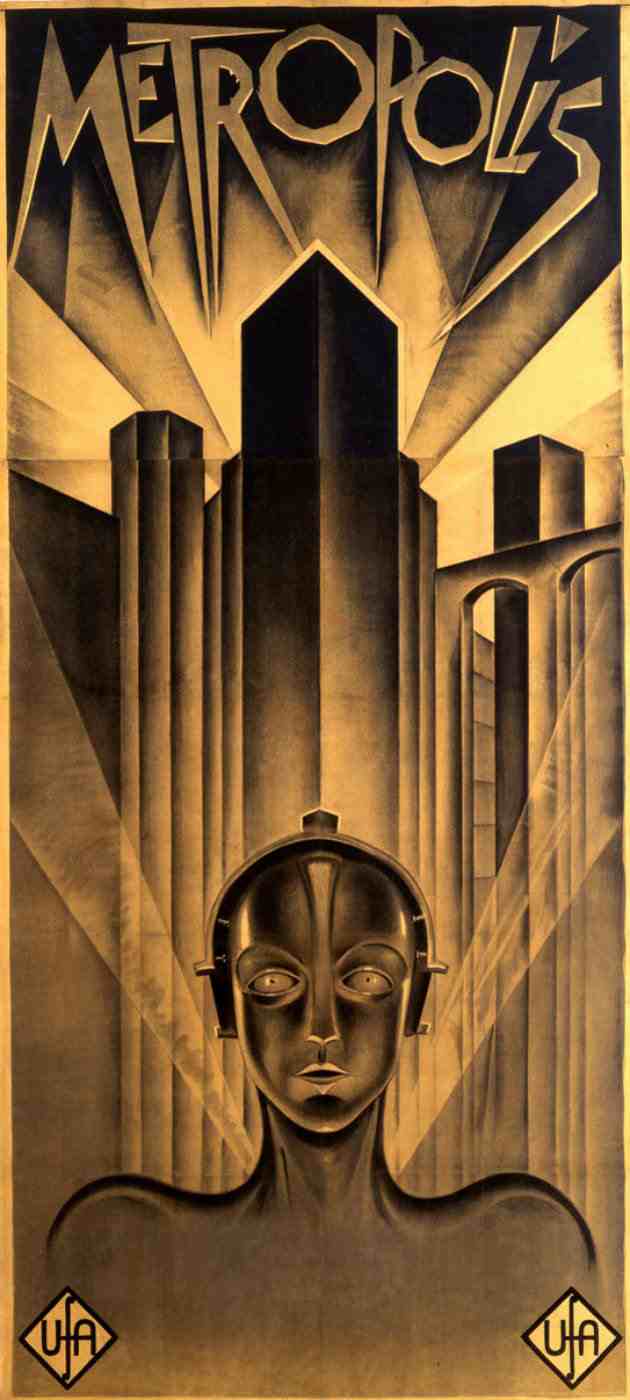
Metropolis Film Review

Fig 1: Poster for Metropolis

The film "Metropolis" is a black and white German film from 1927 and is hailed as the grandfather of science fiction with, the producer, Fritz Lang's vision still inspiring and invigorating audiences today. It is a classic example of a pioneering work as well as highlighting and projecting the class divisions of its time, 1927, onto the far off future.
The film itself is bursting with original ideas along with time old concepts and ideology, with biblical stories and ideology firmly rooted throughout its entirety as well as a Marxist perspective embedded within it. "A visionary science-fiction spectacle; a still relevant dramatization of 'class warfare'; a pulp nightmare of Freudian-Marxist-Christian symbolism and Expressionist-Futurist-Old Testament imagery; and a source of inspiration for Nazis and Utopians alike." (Beifuss 2012) The quotation above gives a very diverse list of elements that can be referenced from Lang's film, a Freudian perspective can be take when it comes to the films feature character the Machine-man and its sexually geared design scheme, a blend of high/future technology and eroticism.
Fig 2: The false Maria is sits on pedestal support by the seven deadly sins.
 
The abundance of references towards Christian mythology and biblical stories are essential to the core design of the film, with its storyline taking key influence from the story of the Tower of Babel, and man's vanity and pride in challenging God. Among the influences Lang takes from biblical or religion as a whole is the search or reverment of a "messianic figure who can find a middle way between the head and the heart, the bosses and the workers: he will be the Mediator, or the "Mittler" " (Bradshaw 2010) This character would bring peace and prosperity to all, as is the trend with such figures mention through religious texts. Although, this specific reference to the bible holds a much more, but completely unintended, contextual reference to the political climate at the time of its creation. Adolf Hitler, who was said to have enjoyed this particular film, would have perhaps appeared as real-life example of the mediator character, an all too chilling thought years after the war.
 
The theme of challenging God, the creator, in conjunction with a science fiction setting not only builds upon how powerful god is, when the creation is finally crushed by God' power, but on the humanity's vices which are better know as the seven deadly sins. This religious concept of having seven sins that are guaranteed to not only kill you but send you to a spiritual plane of eternal damnation is ever present throughout Metropolis, such as Joh Fredersen's pride in himself and his city, Rotwang's envy towards Fredersen, the rich sons lustfully chasing after skimpily clothed women in the garden, the wrath of the proletariat as they burn the robot Maria, etc. A scene which echoes this theme of challenging God is when Rotwang first shows Joh Fredersen the Machine-man, the presence of a pentacle in the background hints towards this theme and is commonly associated with satanic worship and black magic which are elements of supposedly ungodly worship and shows how removed from sanctioned practices Rotwang's work is, Fredersen's fearful reaction also links to this theme when he sees this seemingly ungodly construct begin to move and his slight movement away from it when it offers its hand.
 
Fig 3: Rotwang shows Fredersen the Machine-man.
 
The way in which Lang envisioned the future through Metropolis holds true even now, the concept of the mega-city and one built upon the blood and flesh of the proletariat is reflected around the world; Tokyo, Dubai, London, New York, each of these capitals are placed within the mega-city category and are themselves built, maintained and expand by the working class while the upper class or bourgeoisie administrate and control them. They are the breeding grounds of capitalist ideology and Lang creates his city with such similarity it is hard to imagine that it was conceived and created 86 years ago. This is why "Metropolis retains its power to overwhelm, trouble and move..." (Scott 2002) can connect so closely to a modern audience because of its close relation and near similarities to modern life and its connection "...to the deep anxieties of modern life as if by a high-voltage cable." (Scott 2002) and that "high-voltage cable" is what really shocks audiences, Lang's understanding and, like Maria, prophetic imagination has and continues to fuel many universes created since.
 
 
List of Illustrations:
 
 
Fig 2: False Maria on Seven Sin Pedestal scene from Metropolis (1927)
          Directed by Fritz Lang, At: http://www.cyberpunkreview.com/images/metropolis05.jpg
 
Fig 3: Rotwang show Fredersen the Machine-man scene from Metropolis (1927)
 
Bibliography:
 
Beifuss, John (2012) http://www.rottentomatoes.com/m/1013775-metropolis/ (Online Review) (Accessed 01/10/13)
 
 
Bradshaw, Peter (2010) http://www.theguardian.com/film/2010/sep/09/metropolis-restored-film-review (Online Review) (Accessed 01/10/13)