Showing posts with label cinematic spaces film reviews. Show all posts

Monday, 21 October 2013

2001: Space Odyssey Review

Fig 1: 2001 Space Odyssey Poster


The film "2001 A Space Odyssey" is a extremely abstract film with little in the way of a solid storyline. Directed by Stanley Kubrick and Arthur Clarke, the author whose book the film was adapted from, the film takes a profound approach in its debating of philosophical ideas and arguments, the first of these being the birth of humanity. The birth of humanity is torn between religious and scientific origins, both having valid points and affirming their own theories but it is obvious from the beginning of the film that Kubrick opted for the scientific theory, this being Darwin's theory of evolution, and takes the audience on a journey through the first part of the film as he explores and portrays the moment our ancestors took tools into their hands and used them for violence. "Stanley Kubrick's 2001: A Space Odyssey is one of the greatest films of all time and it is the director's most profound and confounding exploration of humanity's relationship to technology, violence, sexuality and social structures." (Caldwell 2011) This statement by Caldwell highlights the way in which Kubrick ties the core or, as he portrays, primal aspects of humanity into our advancement from ape-like creatures into something more sophisticated. In the scene mentioned before,he creates a moment where both primal aggression and human ingenuity are combined into our species first steps in technological development. The beauty of this scene is awe inspiring as Kubrick's imagination captures the emotion and brutality of the scene perfectly, when on ape strikes another and kills it can be interpreted as the destruction of the primal self, the door way to the future opened by a single act of both intelligence and violence.


Fig 2: Ape monolith scene


That moment in 2001:A Space Odyssey was marked by the appearance of a black monolith, an imposing and frightening looking slab that acts as a prompt for the advancement of man or simply as a marker for the moment of that advancement. The film then skips millions of years ahead to a time where humanity has mastered space travel, with shuttles taking people from earth to the moon like aeroplanes of the modern day ferry people around the world. This brief look at humanities advancements serve only to excite the audience at the prospect such wonders, with Kubrick's sets and special effects making the scene incredibly believable to even a modern audience. It appears that man has mastered the space travel, conquering that have been above our heads and beyond our reach for a millennium. This is played down though by the dicovery of an artefact buried on the moon, the audience is kept i suspense about just what the object is until they are actually shown it and it is in this special but horrifying moment that the audience lays eyes on the familiar shape of a black monolith. "The plot is not so much of structure but rather of events or moments in time that are united by the appearance of a large black monolith." (Haflidason 2001) This quotation perfectly represents the audience's realisation, as well as the now outlandish thought to which Kubrick provides a completely creative but insane scenario for because if the monoliths really do mark the advancements of humanity, where is there to go beyond the stars?


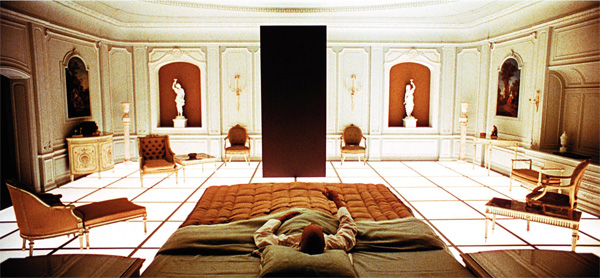
Fig 3: Final monolith scene


Kubrick's answer to this question comes with the overwhelming special effects and a bright white room. A mission to Jupiter is launched and with several men in cryogenic pods and a super computer by the name of HAL 9000 to investigate an anomaly, but with an error from the super computer the entire voyage becomes litter with the deaths of the crew members as the computer goes about systematically killing them off, setting the standard for evil super computers in all forms of fiction (an example of this would be GLaDOS). "The final sequence of 2001 is speculation through imagination, positing a new Xanadu, a world of wonders where time and space no longer exist, just as the rest of the film speculates on various levels, exploring the new vistas opened up by the encroaching space era" ( The Observer 1968) The remaining crew member is transported to Kubricks answer, where time and space is irrelevant and everything is neither past, present or future. This "new Xanadu" is the accumilation of everything and is both a profound philosophical answer to the questions that desperately what answering, for both past and present audiences.


List of Illustrations:


Fig 1: 2001: A Space Odyssey poster (1968) At: http://inktank.fi/17-little-know-facts-about-2001-a-space-odyssey/


Fig 2: Ape monolith scene from 2001: A Space Odyssey

Directed by Stanley Kubrick, At: http://onlyhdwallpapers.com/space/movies-2001-a-space-odyssey-desktop-hd-wallpaper-240678/


Fig 3: Final monolith scene from 2001: A Space Odyssey

Directed by Stanley Kubrick, At: http://www.collativelearning.com/PICS%20FOR%20WEBSITE/stills%202/2001_a_space_odyssey_movie_image__3_.jpg


Bibliography:


Caldwell, Thomas (2011) http://www.rottentomatoes.com/m/1000085-2001_a_space_odyssey/ (Online Review) Accessed 21/10/13


Haflidason, Almar (2001) http://www.bbc.co.uk/films/2000/09/18/2001_review.shtml (Online Review) Accessed 21/10/13


The Observer Newspaper (1968) http://www.theguardian.com/film/2010/oct/21/space-odyssey-review-science-fiction (Archived Newspaper Review) Accessed 21/10/13

King Kong Review

Fig 1: King Kong Poster


The film King Kong is a extremely iconic film, with several adaptations each trying to capture the classic story of a damsel in distress. The original film (1933) was produced and directed by Merian Cooper and Ernest Schoedsack and is a landmark if film history. The film's plot is generic, a damsel in distress needs rescuing from some evil force by the valiant white knight, but beyond that outline is where the plot begins to change into something that has captivated audiences for decades. The damsel, Ann Darrow, is whisked away by the film producer Carl Denham who plans to voyage to a uncharted island for his next movie only for Ann to be kidnapped by the giant ape, Kong. "The story, like "Frankenstein" and "Dracula," has taken on the significance of a modern folk tale, layered with obvious moralizing and as familiar as personal history." (Smith 1991) The unique story of King Kong has left its mark in history and filmic practices, being remade several times with each new version attempting to recreate the success of the original and reinvigorate a story that has become, as Smith puts it, modern folk tale in its own right.


Fig 2: Kong Attacking a plane scene


The film is full of topics, stereotyping, race, class and sexism being among the most prominent and obtuse. The attitude towards race in King King can be classed as appalling, the faked Chinese accent, the multitude of black actors used for the islanders and Carl Denham's line about the team with him being the first whites to set foot there all have a poor taste in any audiences mouth, "...viewers will shift uneasily in their seats during the stereotyping of the islanders in a scene where a bride is to be sacrificed to Kong..." (Ebert 2002) with a reaction just like the one Ebert describes a familiar feeling to those who have viewed the film. Although the film does border on the outright offensive, it does not diminish the spectacle granted to us, "...from the moment Kong appears on the screen the movie essentially never stops for breath." (Ebert 2002) with the films special effects so awe inspiring for the time period and really bringing the spaces to life, even for a modern audience, and the amount of creativity and entrancing visuals playing with the audiences imaginations like putty.


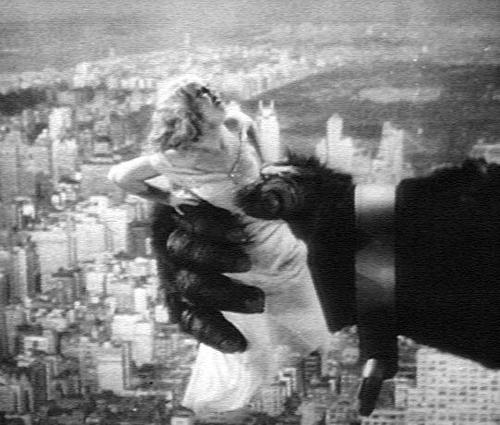
The portrayal of women in the film is poor, with Ann Darrow being a completely passive character to the events around her and being pulled about in the story's flow. This stereotypical view of women may have been accurate for its time period (1930s) but only when in the environment of 'civilised' society, as a human's base instinct to survive and by any means possible is identical regardless of sex. The way in which Ann has been portrayed may have been to frustrate women watching the film, showing a reflection of the 1930 female stereotype so flatly to them as provocation. "An icon of pop culture with truly erotic and emotionally touching scenes between Fay Wray and the massive gorrilla" (Levy 2011) The scenes in which Levy speaks of are at best elusive, with Ann, played by actor Fay Wray, screaming at the top of her lungs throughout many of the scenes with Kong in primal fear of him, leaving very little or no room for interaction between the two beyond her being held like a toy in his hand. The elusive nature of these scenes brings the audiences feelings of sympathy to lay solely on Ann by the end of the film with her traumatic ordeal over and Kong dead.


Fig 3: Kong holding Ann scene


List of Illustrations:


Fig 1: King Kong Poster (1933) At: http://www.best-horror-movies.com/image-files/king-kong-1933-poster.jpg


Fig 2: Kong attacking a plane scene from King Kong (1933)

Directed by Merian Cooper and Ernest Schoedsack, At: http://upload.wikimedia.org/wikipedia/en/8/88/Img_kingkong1.jpg


Fig 3: Kong holding Ann scene from King Kong (1933)

Directed by Merian Cooper and Ernest Schoedsack, At: https://blogger.googleusercontent.com/img/b/R29vZ2xl/AVvXsEhq46_LmRysg3dJ9URz1vhycuoJ5HUWg2ZeNd9n9FT-y6GL0-YT0sju4flpF_wH29fLfocAHXJHGn3mL_-YYxwGmksg_OK8OmxfqfYsh7tnCpclnzsvFHX_dmCnXmdwOVSAkkyQLe9sFrQ/s1600/KINGKONGfay-wray.jpg


Bibliography:


Ebert, Roger (2002) http://www.rogerebert.com/reviews/great-movie-king-kong-1933 (Online Review) Accessed 21/10/13


Smith, Mark Chalon (1991) http://articles.latimes.com/1991-10-24/news/ol-253_1_king-kong (Online Review) Accessed 21/10/13


Levy, Emanuel (2011) http://www.rottentomatoes.com/m/1011615-king_kong/ (Online Review) Accessed 21/10/13

The Cabinet of Dr Caligari Review

Fig 1: "The Cabinet of Dr Caligari" Poster


"The Cabinet of Dr Caligari" is a 1920 German silent movie directed by Robert Wiene and is considered one of the greatest silent horror films created. The plot of "The Cabinet of Dr Caligari" revolves squarely around two of the main characters in the film, the first being Francis who is the protagonist of the tale and the second is Dr Caligari who appears to be the antagonist. The design of these characters is interesting in itself as Dr Caligari is portrayed as a absolute fiend, secretly murdering whoever he wishes with the sleepwalker/somnambulist Casare, slithering around the films environments and fooling everyone with his 'act' as the head doctor of an asylum. This contrasts greatly with the characteristics of the lead protagonist who is portrayed as having a strong sense of justice, smarter than the authorities and a shrewd detective as he figures out Dr Caligari's real identity. These two designs are so simplistic in their portrayal of their respective characters that it can even appear as if the film is a child's book with the battle between a hero and a villain that contrast each other completely and show no blurring to whether they are good or evil. "None of them can quite be believed, nor can they believe one another." (Ebert 2009) The way Ebert describes Wiene's characters could not be more apt, the design is so simplistic and flat, with little beyond their exterior shell that could be considered a personality but this is done purposefully so as to encourage them to be unbelievable to the audience.


Fig 2: Rooftop chase scene


The set design of the film mirrors this theme of the unbelievable with its quirky layout and architecture that takes heavy influence from German expressionism as a way of portraying the twisted and warped emotional state of the protagonist and his unstable mentality. The way Wiene has faithfully reproduced the artists vision lends aid to the unbelievable factor of the films main plot and characters, as they glide through their unnatural landscape completely accustomed by its warped shape. "Robert Wiene has made perfect use of settings designed by Hermann Warm, Walter Reimann and Walter Roehrig, settings that squeeze and turn and adjust the eye and through the eye the mentality." (Variety Staff 2006) This quotation above highlights specifically how the quirky sets twist and change the audiences viewing of film considerably and are used specifically to do so. The sets may have been cheaper to use then their realistic counterparts, but as the ending twist to the film suggests, they set the tone, mood for this surprise ending to really explain the purpose and meaning behind the use of such sets.


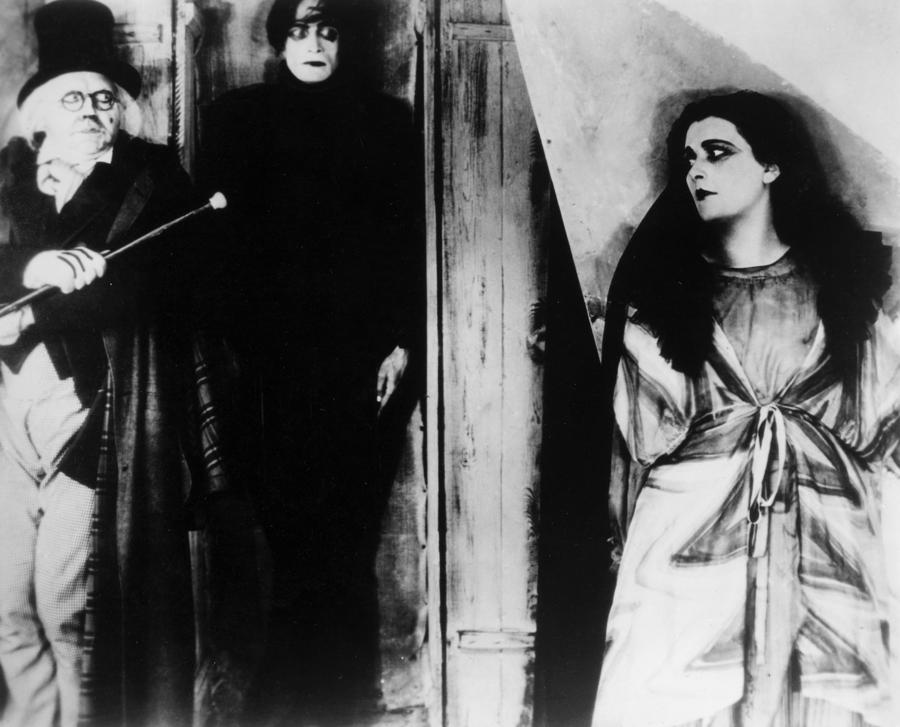
Fig 3: Jane visits Dr Caligari's Tent


The scene shown above is the scene when the female lead, Jane, visits Dr Caligari's tent in search of Francis and her father. This is a eerie and frightening scene within the film as Wiene stretches out the encounter and Cesare's awakening to build a sense of agonising suspense, which is only heightened by Jane's flailing and overly dramatic reactions. "The narrative frame creates ambiguities that hold certain elements of the story in disturbing suspension" (Rosenbaum 2007) The pure fact that the film is silent is what allows this painful suspense and fright to grow and develop as the audience must watch both murder and kidnapping take place without a sound, the frightening horror as the other characters rush to aid the assailed individual but, despite their visual desperation and emotional state, they cannot help and they themselves must watch with the audience Dr Caligari scheming and Cesare's murderous streak grow while powerless to stop it, and it is this sense of powerlessness that captures the audiences breathes, from 1920 to now, again and again.


List of Illustrations:


Fig 1: "The Cabinet of Dr Caligari" poster (1920) At:http://verdoux.files.wordpress.com/2008/04/the-cabinet-of-dr-caligari.jpg


Fig 2: Rooftop chase scene from The Cabinet of Dr Caligari (1920)

Directed by Robert Wiene, At: http://quietus_production.s3.amazonaws.com/images/articles/1003/caligari_1232121486_crop_550x441.jpeg


Fig 3: Jane Visits Dr Caligari's Tent scene from The Cabinet of Dr Caligari (1920)

Directed by Robert Wiene, At: http://images.fineartamerica.com/images-medium-large/the-cabinet-of-drcaligari-granger.jpg


Bibliography:


Ebert, Roger (2009) http://www.rogerebert.com/reviews/great-movie-the-cabinet-of-dr-caligari-1920 (Online Review) Accessed 21/10/13


Variety Staff (2006) http://www.rottentomatoes.com/m/1003361-cabinet_of_dr_caligari/ (Online Review) Accessed 21/10/13


Rosenbaum, Jonathan (2007) http://www.chicagoreader.com/chicago/the-cabinet-of-dr-caligari/Film?oid=1068606 (Online Review) Accessed 21/10/13

Wednesday, 2 October 2013

Metropolis Film Review

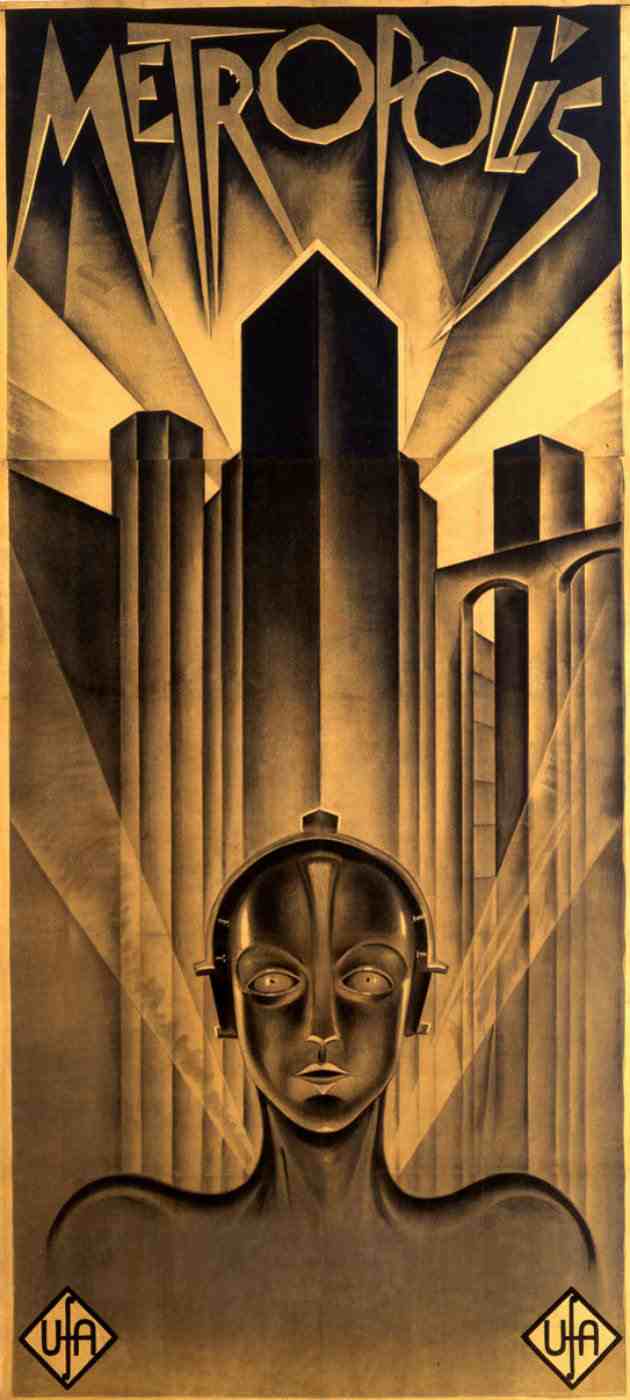
Fig 1: Poster for Metropolis

The film "Metropolis" is a black and white German film from 1927 and is hailed as the grandfather of science fiction with, the producer, Fritz Lang's vision still inspiring and invigorating audiences today. It is a classic example of a pioneering work as well as highlighting and projecting the class divisions of its time, 1927, onto the far off future.
The film itself is bursting with original ideas along with time old concepts and ideology, with biblical stories and ideology firmly rooted throughout its entirety as well as a Marxist perspective embedded within it. "A visionary science-fiction spectacle; a still relevant dramatization of 'class warfare'; a pulp nightmare of Freudian-Marxist-Christian symbolism and Expressionist-Futurist-Old Testament imagery; and a source of inspiration for Nazis and Utopians alike." (Beifuss 2012) The quotation above gives a very diverse list of elements that can be referenced from Lang's film, a Freudian perspective can be take when it comes to the films feature character the Machine-man and its sexually geared design scheme, a blend of high/future technology and eroticism.
Fig 2: The false Maria is sits on pedestal support by the seven deadly sins.
 
The abundance of references towards Christian mythology and biblical stories are essential to the core design of the film, with its storyline taking key influence from the story of the Tower of Babel, and man's vanity and pride in challenging God. Among the influences Lang takes from biblical or religion as a whole is the search or reverment of a "messianic figure who can find a middle way between the head and the heart, the bosses and the workers: he will be the Mediator, or the "Mittler" " (Bradshaw 2010) This character would bring peace and prosperity to all, as is the trend with such figures mention through religious texts. Although, this specific reference to the bible holds a much more, but completely unintended, contextual reference to the political climate at the time of its creation. Adolf Hitler, who was said to have enjoyed this particular film, would have perhaps appeared as real-life example of the mediator character, an all too chilling thought years after the war.
 
The theme of challenging God, the creator, in conjunction with a science fiction setting not only builds upon how powerful god is, when the creation is finally crushed by God' power, but on the humanity's vices which are better know as the seven deadly sins. This religious concept of having seven sins that are guaranteed to not only kill you but send you to a spiritual plane of eternal damnation is ever present throughout Metropolis, such as Joh Fredersen's pride in himself and his city, Rotwang's envy towards Fredersen, the rich sons lustfully chasing after skimpily clothed women in the garden, the wrath of the proletariat as they burn the robot Maria, etc. A scene which echoes this theme of challenging God is when Rotwang first shows Joh Fredersen the Machine-man, the presence of a pentacle in the background hints towards this theme and is commonly associated with satanic worship and black magic which are elements of supposedly ungodly worship and shows how removed from sanctioned practices Rotwang's work is, Fredersen's fearful reaction also links to this theme when he sees this seemingly ungodly construct begin to move and his slight movement away from it when it offers its hand.
 
Fig 3: Rotwang shows Fredersen the Machine-man.
 
The way in which Lang envisioned the future through Metropolis holds true even now, the concept of the mega-city and one built upon the blood and flesh of the proletariat is reflected around the world; Tokyo, Dubai, London, New York, each of these capitals are placed within the mega-city category and are themselves built, maintained and expand by the working class while the upper class or bourgeoisie administrate and control them. They are the breeding grounds of capitalist ideology and Lang creates his city with such similarity it is hard to imagine that it was conceived and created 86 years ago. This is why "Metropolis retains its power to overwhelm, trouble and move..." (Scott 2002) can connect so closely to a modern audience because of its close relation and near similarities to modern life and its connection "...to the deep anxieties of modern life as if by a high-voltage cable." (Scott 2002) and that "high-voltage cable" is what really shocks audiences, Lang's understanding and, like Maria, prophetic imagination has and continues to fuel many universes created since.
 
 
List of Illustrations:
 
 
Fig 2: False Maria on Seven Sin Pedestal scene from Metropolis (1927)
          Directed by Fritz Lang, At: http://www.cyberpunkreview.com/images/metropolis05.jpg
 
Fig 3: Rotwang show Fredersen the Machine-man scene from Metropolis (1927)
 
Bibliography:
 
Beifuss, John (2012) http://www.rottentomatoes.com/m/1013775-metropolis/ (Online Review) (Accessed 01/10/13)
 
 
Bradshaw, Peter (2010) http://www.theguardian.com/film/2010/sep/09/metropolis-restored-film-review (Online Review) (Accessed 01/10/13)


Wednesday, 25 September 2013

Le Voyage Dans La Lune (1902) Film Review

Fig 1 - Le Voyage Dans La Lune's Title card.
The film “Le Voyage Dans La Lune” is a black and white silent movie produced in 1902 by George Melies. The film is, as stated in its title, about a group of scientists/magicians who achieve flight to the moon, a preposterous theory just after the turn of the century. This can be seen through the use of wizards and magic and can be seen as alluding to how mystifying and magical science seems, as well as also allowing the use of the more questionable means of transportation to the moon, as is seen when they use a enormous cannon to accomplish the task.

Melies portrays his environments with a tremendous sense of scale and depth, using illusion and perspective to create, what would have seemed in 1902, an entirely believable world. It is scenes like the one below in which Melies creates a feeling of wonder and awe in his audience even now. Its mysticism invigorates the imaginations of its audience with Melies' own "Typical Imaginative Flamboyance"(David Parkinson, 2011) providing some of more inspiring and eccentric scenes in this film, such as the mushroom cave scene or the alien camp scene where a certain type of eccentricity gives life to these odd creations.

"Each image just another piece of magic"(Will, 2011) is a quotation that relates partially to the the enormous landscapes and vivid locations and partially to the early special effects employed by Melies to stun, captivate and amaze his audiences. The effects used for conjuring chairs out of tubes and making the alien life forms turn to smoke when hit were cutting edge for their time, using stop and start techniques that would have had audiences astounded and mystified as they tried to workout just how it had been done.


Fig 2 - The moon scene where the
adventurous scientists sleep for the night.

The industrial scene captures the essence of what would have been reality and adds flair of innovation to it, the use of perspective and the illusion of space drags the viewer deeper into Melies' world and gives the scene a sense of realism and give it a believable quality. It is this sense of realism that really brings the charm of this silent film to life, the fact that this could have been reality, what may seem like outlandish inventions and completely insane notions to us now gave audiences an exciting but all too possible future.
Fig 3 - The industrial landscape scene showing
the construction of the large cannon.

"The primitive silent landmark has more charm and originality than many modern CGI-cluttered epics."(Phil Hall, 2004) This quotation shows how this "silent landmark" has the originality that far surpasses modern films, Melies' film captures something from audiences that its modern counterparts have lost sight of.  It is in the notion of realism and the coming future that Melies captures his audiences hopes and fears, what is to come with the new century, what strange and otherworldly concoctions and inventions will revolutionize humanity and what great feats of innovation and engineering will reshape the common mans way of life.

List of Illustrations:

Figure 1: Title card from Le Voyage Dans La Lune (1902)
              Directed by George Melies At: http://annyas.com/screenshots/images/1902/voyage-dans-la-lune-title-still-small.jpg ( Accessed 25/09/13)

Figure 2: Moon sleep scene from Le Voyage Dans La Lune (1902)
              Directed by George Melies. At: http://drnorth.files.wordpress.com/2010/06/le-voyage-dans-la-lune-georges-melies-1902-tableau-7d.png?w=584&h=438 ( accessed 25/09/13)

Figure 3: Industrial landscape scene from Le Voyage Dans La Lune (1902)
              Directed by George Melies At: http://drnorth.files.wordpress.com/2010/06/le-voyage-dans-la-lune-georges-melies-1902-tableau-3.png?w=584&h=438 ( Accessed 25/09/13)

Bibliography:

Hall, Phil (2004) http://www.rottentomatoes.com/m/trip_to_the_moon-1902/ (Online Review)

Parkinson, David (2011) http://www.empireonline.com/reviews/reviewcomplete.asp?FID=134388 (Online Review)

Will (2011) http://www.the-filmreel.com/2011/02/25/a-trip-to-the-moon-1902-film-reel-reviews/ (Online Review)